Soenda
Description
In the past twenty years, the Indische Buurt in Amsterdam has been radically renovated. From a poorly maintained neighborhood to a lively residential area. Streets and squares were given a facelift and thousands of homes were refurbished or replaced. Yet the social character that makes this neighborhood so special has not been lost. This is clearly reflected in the new Soenda residential building of M3H, where meeting is central.
Housing blocks are often designed purely for private use and are therefore set back from the street. With the Sunda block it is exactly the opposite. In the design, the focus is on making contact. Contact with the street, with the neighborhood and with each other.
Maisonettes, town houses and apartments
The Sundablok consists entirely of social housing. In total, the Sundablok has 130 homes. Thanks to these types of projects, the renovated Indische Buurt also remains accessible to various population groups.
There are maisonettes on the ground floor and the first floor. These 'city houses' each have their own garden and front door, with which they make contact with the street. This promotes liveliness and interaction with the neighbourhood. The floors above are filled with apartments. These apartments are twice as wide (8.4 meters) and have many windows at the front and rear. This stimulates contact and social interaction between the residents.
Meetings are also encouraged outside the home. In the design it was decided to place short galleries. The outdoor areas are also located at the ends of this. The meeting actually starts at the entrance. The main entrances and stairwells are designed relatively broadly, in order to contribute to a pleasant feeling of coming home and coming together.
A closer look
If you look at the building, you will see the galleries that meander from the outside in. This creates a varying facade image. Are you getting closer to the building? Then you see that the masonry consists of horizontal and vertical masonry bond. You will also see more than one entrance. The more than one hundred meters long block has four main entrances. These entrances divide the block into three parts. In places where you can approach and touch the building, such as at the individual front doors and main entrances, extra attention has been paid to the details and the materials used.
Green details
Residents of the town houses have a garden that borders the collective garden, which is almost a hundred meters long. This communal garden is for all residents. The green courtyard gives every resident a sense of collectivity and contributes to the biodiversity in the city. The courtyard becomes increasingly spacious towards the top due to the receding facades and galleries.
The block has even more green features. Both visible, such as the specially designed balcony fences on which residents can place flower boxes, and invisible. For example, the roof is covered with solar panels. Each house has its own solar panels. In addition, the panels provide the lighting in the stairwells and the parking basement with power, and there are a number of charging stations for electric cars in the basement.
PARTNERS
The Alliance, client
Adams Bouwadviesbureau, constructor
Coen Hagendoorn Construction, contractor
Expertise: Architecture Features or Specials: Garden, Shared space, Social housing, Solar panels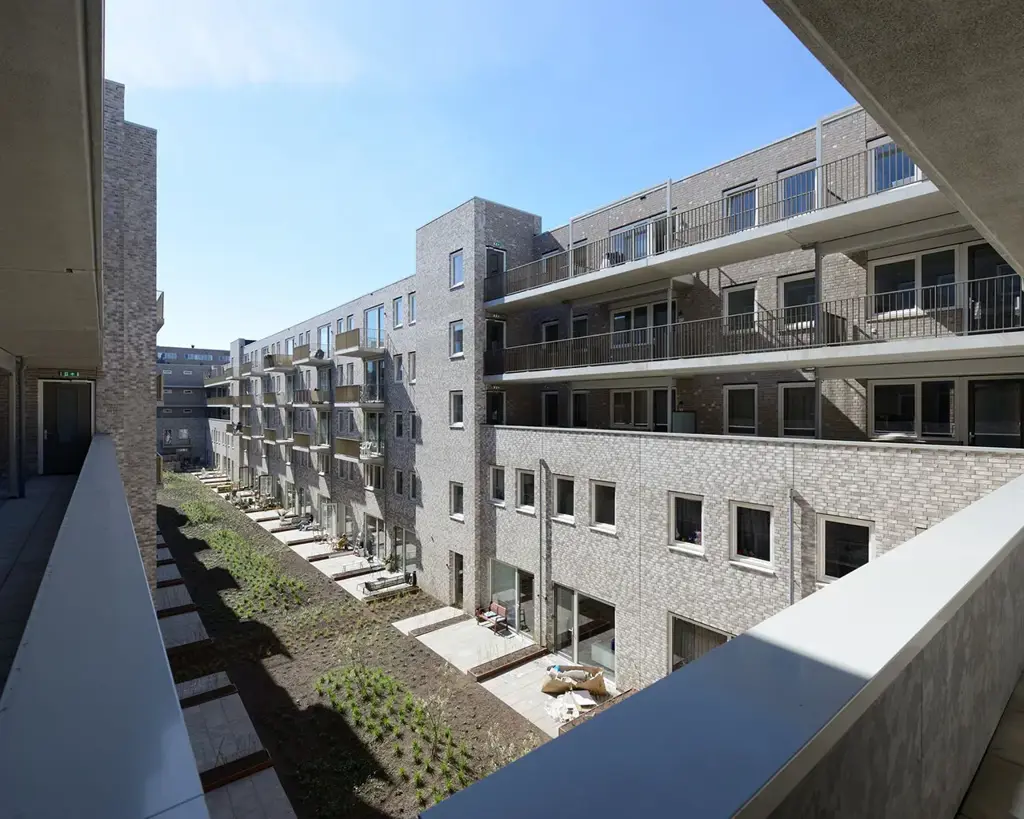

Werk ook slimmer met Galleo
Galleo brengt projectdata, kennis en AI samen in één veilige, schaalbare oplossing. Toonaangevende bedrijven zoals ABT, DWA, CLAFIS en Witteveen+Bos kiezen al voor Galleo. Sluit je aan.
Neem contact op met Barbara of Kars
We werken zelf in de gebouwde omgeving en adviseren je graag, met praktijkervaring en vakkennis, over wat het beste werkt voor jouw organisatie.
Neem contact op